Why Prague Has Quietly Become the Preferred Escape for America's Most Discerning Executives
The Shift No One Is Announcing Out Loud
Among the senior partners, C-suite executives, and private equity principals who move quietly through Europe's finest hotels, a pattern has emerged over the past several years. The conversations happen in business lounges and over post-dinner cognac rather than in press releases: Prague has become the go-to destination for American executives who want Europe on their own terms.
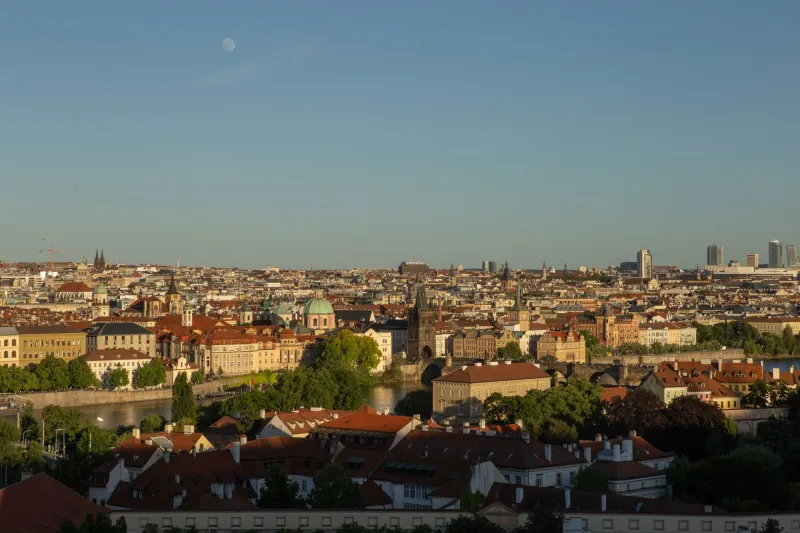
This is not the Prague of student backpackers or bachelor parties — though that reputation, however outdated, persists in certain corners of the internet. The Prague that high-net-worth American travelers are discovering is something else entirely: a city of extraordinary architectural beauty, sophisticated cultural programming, and a service economy that has matured rapidly to meet the demands of an increasingly discerning international clientele.
Understanding why this city has captured the attention of professionals who could afford to be anywhere requires looking beyond the obvious.
Geography as Strategy
Prague occupies a position in the center of Europe that is, from a logistical standpoint, almost suspiciously convenient. Within two hours by air, a traveler can reach London, Paris, Berlin, Vienna, Warsaw, Budapest, and Zurich. For executives who use European trips as multi-city business tours rather than single-destination vacations, Prague functions as an ideal operational hub — a place to decompress between meetings in Frankfurt and Warsaw, or to spend a long weekend before flying into Geneva for a Monday morning close.
Direct transatlantic routes from New York, Chicago, and Washington, D.C. have expanded meaningfully in recent years, reducing the friction that once made Prague feel like a secondary stop rather than a primary destination. American travelers who once routed through London or Amsterdam to reach Central Europe are increasingly finding that Prague stands well on its own as a point of entry.
This geographic centrality is not merely a convenience for the itinerary. It shapes the character of the city itself. Prague has long served as a meeting point between Western European commercial culture and the more reserved, intellectually rich traditions of Central and Eastern Europe. The result is a social environment that feels simultaneously cosmopolitan and intimate — large enough to offer genuine anonymity, compact enough to reward those who know where to look.
The Infrastructure Argument
Luxury travel infrastructure in Prague has undergone a quiet transformation. The city now hosts properties representing virtually every major international hotel group at the five-star tier, alongside a growing collection of boutique hotels occupying restored baroque palaces and art nouveau townhouses that simply do not exist in cities built primarily after the Second World War.
Restaurant culture has followed a similar trajectory. Prague's fine dining scene, once dismissed as a regional curiosity, now commands serious attention from international food media. Michelin recognition has arrived, and with it, a culinary ecosystem capable of satisfying guests whose reference points include meals in Tokyo, New York, and Copenhagen.
For executives accustomed to a certain standard of service, the city delivers without requiring the exhausting vigilance that some European capitals demand. Prague operates at a pace that feels considered rather than frantic. Reservations are honored. Privacy is respected. The transactional aggression that can make other tourist-heavy cities feel wearing is largely absent here.
Discretion as a Cultural Value
Perhaps the most underappreciated element of Prague's appeal to high-net-worth American travelers is the city's relationship with privacy. Czech culture does not fetishize public visibility the way that certain Western European capitals do. There is no equivalent of the paparazzi culture that makes a quiet dinner in London or a walk through central Paris feel like a calculated risk for anyone with a public profile.
This cultural disposition toward discretion extends into the professional services sector. Companion and hospitality services in Prague — including the curated, intelligent companionship offered through platforms like Prague Companions — operate within a framework of confidentiality that experienced clients recognize and value. The expectation of privacy is not a selling point that needs to be advertised aggressively; it is simply the baseline.
For American executives who have grown accustomed to the surveillance economy at home — where every transaction, movement, and communication generates a data trail — the relative anonymity of a well-managed stay in Prague can feel genuinely restorative.
The Companion Advantage in a City Built for Connection
Prague's social landscape rewards those who arrive with local knowledge and genuine cultural fluency. The city's most interesting experiences — its private gallery openings, its jazz cellars, its members' clubs, its rooftop terraces overlooking the Vltava at dusk — are not hidden exactly, but they are not on the tourist map either.
This is where the value of elite companion services becomes most apparent. A well-connected companion in Prague is not simply a social accessory; she is a navigator, a translator of cultural context, and a professional whose understanding of the city extends well beyond the standard concierge script. For an American executive arriving for four or five days with limited time to orient himself, the difference between experiencing Prague at surface level and experiencing it with genuine depth is almost entirely a function of who accompanies him.
The companions available through Prague Companions represent a specific kind of professional: educated, multilingual, socially sophisticated, and deeply familiar with the city's rhythms. They understand that a client who has spent the day managing a complex cross-border transaction does not need entertainment so much as calibrated company — conversation that engages without demanding, presence that restores rather than depletes.
What Prague Offers That Traditional Luxury Destinations Cannot
The established European luxury circuit — Paris, London, Monaco, the Amalfi Coast — offers something Prague does not: name recognition. For executives who travel to be seen, or whose concept of luxury is inseparable from social signaling, those destinations retain their appeal.
But a meaningful segment of high-net-worth American travelers has quietly moved past that calculus. These are professionals for whom the purpose of travel is restoration, strategic thinking, and genuine experience rather than the accumulation of status markers. For this group, Prague's relative obscurity within the luxury conversation is not a deficiency — it is a feature.
The cost differential is also notable. Prague offers accommodations, dining, and personal services at price points that represent genuine value relative to comparable quality in London or Paris, without any sacrifice in standard. For executives managing both their time and their discretionary budgets with precision, this matters.
A Destination That Rewards Intention
Prague does not announce itself. It does not compete for attention with the aggressive self-promotion of cities that have built their economies around mass tourism. It simply exists — beautifully, intelligently, and with a kind of quiet confidence that mirrors the professionals increasingly drawn to it.
For American executives seeking a European retreat that combines genuine cultural richness, logistical efficiency, and the kind of discreet, personalized service that transforms a business trip into something worth remembering, Prague has made its case. The city is not asking to be discovered. It is simply waiting for those discerning enough to find it.