Advent Without the Avalanche: Prague's Year-End Reset for the Over-Scheduled Executive
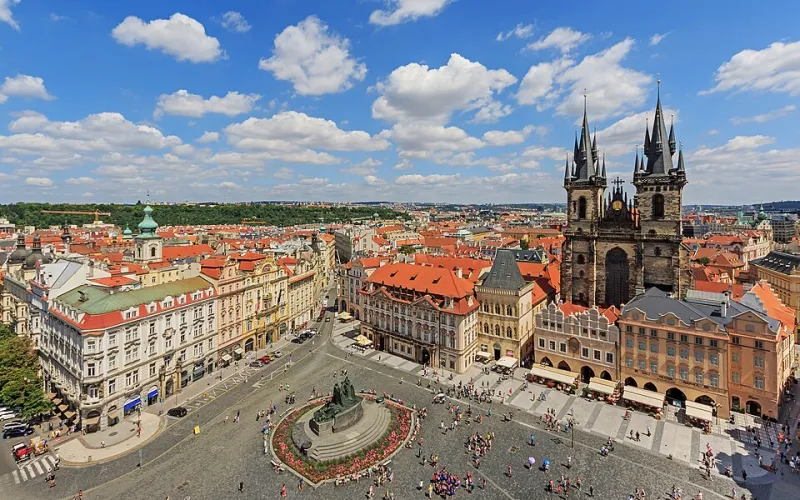
Photo: A.Savin, FAL, via Wikimedia Commons
By the final week of November, the American executive calendar has stopped behaving like a calendar and started behaving like a countdown. Board calls stack against budget reviews, the Q4 close collides with holiday parties that carry as much obligation as cheer, and somewhere between the travel and the small talk the season stops feeling like a gift. It is at precisely this moment that Prague becomes interesting.
Not because the city is empty in December — it is not — but because Prague rewards a particular kind of visitor: the one who refuses to treat the holidays as an itinerary to be survived.
The Year-End Squeeze, Diagnosed
Most December travel is reactive. A flight is booked because a deal appeared, a hotel because a colleague recommended it, a dinner reservation because the alternative was nothing. The result is a trip that reconstructs the same pressure the traveler left behind: scheduled, crowded, and faintly performative.
The smarter approach is to treat the last weeks of the year as a distinct wellness problem rather than a leisure one. What the over-scheduled professional actually needs is not more stimulation but better pacing — fewer decisions, longer pauses, and company that does not require management.
Prague happens to be unusually well suited to that brief.
Why Prague, Why December
Central Europe takes Advent seriously in a way that American cities rarely attempt. The season here is not a retail event bolted onto November; it is a liturgical rhythm that has persisted through empires, occupations, and decades of change. Markets open in the squares with genuine craft behind the stalls. Churches fill with choral programs. The light is low and gold by four in the afternoon, and the city's Gothic and Baroque silhouettes look most convincing against a gray sky.
That atmosphere is available to anyone. What is not available to everyone is the version of it that excludes the shoulder-to-shoulder crowds. That version requires timing, local knowledge, and — more often than clients first expect — the presence of someone who can read a room and quietly steer the evening away from the crush.
Reading the Advent City Quietly
The single most effective tactic is to invert the clock. Groups mass in the main squares from mid-morning through early evening; early risers find the same streets nearly deserted, the same markets unhurried, the same coffee far better simply because there is no queue. A 7 a.m. walk from the Old Town across the river, before the stalls are fully open, is a materially different experience than the same route at noon.
Second: choose churches over squares. December brings a dense program of choral and chamber music in spaces designed for it — vaulted stone, hard pews, extraordinary acoustics. The audience tends to be local, the tickets modest, and the hour and a half passes without a single phone in sight.
Third: accept that the city's best December hours are indoor hours. A gallery morning, a long lunch, a late afternoon performance — this is a rhythm the city supports naturally.
Dining Without the Din
Prague's dining scene has matured considerably, and December is a fine time to notice it, provided one avoids the addresses wedded to holiday parties. The most pleasant evenings tend to happen in smaller rooms: a mid-sized restaurant in Vinohrady, a tasting menu in a converted building near the river, a wine bar that seats twenty and does not take large groups.
There is a practical dimension to this beyond atmosphere. A table for two in a quiet room allows conversation to go somewhere. A table for two in a packed hall guarantees that every sentence is a negotiation against noise — and the point of the trip, after all, was to stop negotiating.
A Companion as Social Anchor, Not Social Obligation
Here is the distinction that matters most, and it is frequently misunderstood. A companion in this context is not decoration and not an add-on to the itinerary. The role is closer to what a skilled chief of staff does for an executive on a demanding trip: absorbs logistics, manages the social temperature, and ensures the principal is never stranded in a room without a conversational partner.
That shows up in small ways. Someone who knows which restaurants handle a late arrival gracefully. Someone who can order for the table without a lengthy discussion. Someone who understands that a client might want forty minutes of genuine exchange followed by forty minutes of comfortable quiet, and who does not experience the quiet as a failure. For a professional whose entire year has been conducted at conversational volume, that fluency is the actual luxury.
It is also why December bookings should be made early. The city's finest tables, the best private guides, and the most experienced companions are committed well before the first week of the month. Waiting until arrival means choosing from what remains — always the least attractive form of spontaneity.
Designing the Low-Stress Escape
A workable seasonal visit looks roughly like this. Arrive on a weekday and give the first day almost no structure beyond a walk and a meal. Place the single cultural commitment — a concert, a gallery — on the second morning, when the traveler is still unhurried. Reserve one afternoon entirely for nothing, since the point of the exercise is to remember what unstructured time feels like. Leave the evenings flexible and let the company, not the schedule, set the tone.
The result is not a holiday in the conventional sense. There are no matching sweaters and no group photographs. What there is instead is a short, private, well-managed interval at the end of a demanding year — which is, for many people, the only kind of rest that actually takes.
Prague in December will be as busy as you allow it to be. Book early, choose small rooms, start the day before the crowds do, and bring someone who understands that the best evening of the season is often the quietest one.