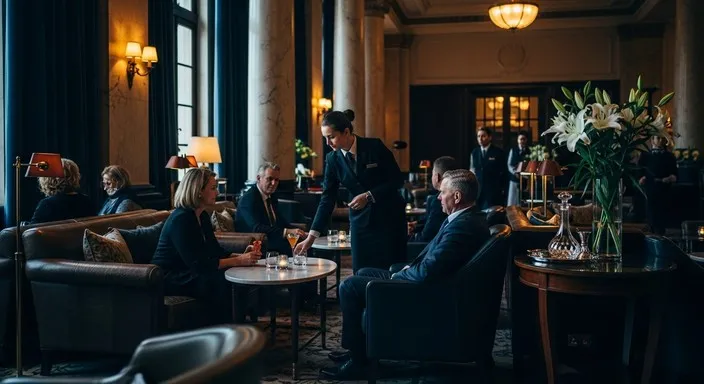
Presence Over Performance: How Elite Companions Have Mastered the Rare Art of Genuine Human Connection
Photo: Collins, Tudor Washington, 1898-1970, photographer, CC BY 4.0, via Wikimedia Commons
There is a particular kind of exhaustion that follows a week of back-to-back meetings, conference calls, and obligatory dinners. It is not physical fatigue — it is the weariness of having spoken at length without ever feeling truly understood. For many accomplished professionals traveling through Europe, this quiet form of isolation has become an unremarkable feature of daily life. What they encounter when engaging with a truly elite companion, however, often surprises them: not entertainment in the conventional sense, but something far more enduring — authentic human presence.
Prague's premier companion services have long attracted discerning international clients, and the reasons go well beyond the city's undeniable beauty. The caliber of interpersonal engagement that defines top-tier companionship in this market reflects a deliberate cultivation of skills that most people — even highly educated, socially adept professionals — never develop with any real depth.
The Psychology of Being Heard
Active listening is a phrase that appears frequently in corporate training seminars, yet it is practiced with genuine fluency by remarkably few people. The distinction between hearing and listening is not merely semantic. Hearing is passive; listening requires sustained cognitive and emotional investment. It means tracking not just the content of what someone says, but the texture of how they say it — the hesitations, the emphasis, the subjects they circle back to without quite arriving at.
Elite companions develop this capacity through consistent, high-stakes social practice. Their professional environment demands that they remain fully engaged across a wide range of conversational registers — from geopolitical analysis to personal reflection — often with individuals they are meeting for the first time. This is not a skill that can be faked convincingly over the course of an evening. It must be genuinely internalized.
For the American executive accustomed to conversations that are primarily transactional — where listening is largely a pause between one's own contributions — this quality of attention can feel almost startling. It creates a psychological safety that encourages more honest, more exploratory dialogue than most professional or social settings permit.
Emotional Intelligence as a Professional Discipline
The concept of emotional intelligence, popularized in the United States through the work of psychologist Daniel Goleman, encompasses the ability to perceive, interpret, and respond to emotional states — both one's own and those of others. In most professional contexts, this capacity is treated as a supplementary advantage. In the world of elite companionship, it is a foundational requirement.
A skilled companion reads a room with precision. They recognize when a client needs animated conversation and when they need comfortable silence. They understand the difference between a person who wants to be challenged intellectually and one who simply wants to feel at ease without the performance demands of their usual social circle. This calibration is not manipulation — it is attunement, and it is a form of social artistry that takes years to refine.
What makes this particularly valuable for high-achieving professionals is that their typical social environment rarely offers this kind of responsiveness. Colleagues have agendas. Family members carry the weight of shared history. Friends, however well-intentioned, bring their own needs to every interaction. A premium companion offers something genuinely unusual: focused, agenda-free presence.
Conversation as a Craft
Beyond listening, there is the matter of contributing meaningfully to a conversation — and this, too, is an area where elite companions distinguish themselves from more casual social encounters.
The companions associated with Prague's premium market are, almost without exception, well-traveled, intellectually curious, and conversant across a broad range of subjects. Many speak multiple languages. Many have academic backgrounds or professional experience in fields ranging from the arts to international business. This breadth is not incidental. It allows for the kind of fluid, genuinely engaging dialogue that educated American travelers — accustomed to stimulating professional environments — find both comfortable and refreshing.
Equally important is the ability to ask questions that open conversations rather than close them. The difference between "What do you do?" and "What brought you to that particular field?" is the difference between a questionnaire and a conversation. Elite companions understand this distinction instinctively. They pursue threads with genuine curiosity, and this curiosity — when authentic — is immediately perceptible.
Why Isolation Has Become the Hidden Tax on Success
Research consistently demonstrates that loneliness is not a condition exclusive to the marginalized or the elderly. It is, in fact, alarmingly prevalent among high-performing professionals — a demographic that, by external measures, appears to have every social advantage. The demands of career success often erode the conditions that sustain meaningful connection: time, vulnerability, geographical stability, and the willingness to be known rather than merely admired.
For the international traveler spending significant portions of the year away from their home base, this dynamic is amplified considerably. Business dinners are transactional. Hotel bars are impersonal. The structured social world of elite travel offers remarkably little space for the kind of unguarded, exploratory conversation that human beings are, at their core, designed to seek.
This is the gap that thoughtful, high-caliber companionship addresses — not as a substitute for deeper relationships, but as a legitimate and valuable form of intentional social engagement in its own right.
What Makes an Interaction Truly Memorable
Clients who reflect on their most meaningful experiences with premium companions consistently return to the same themes: they felt genuinely present, not performing. They spoke about things they rarely discuss. They left the encounter with a sense of clarity, lightness, or renewed perspective that had nothing to do with where they went or what they did.
This outcome is not accidental. It is the natural result of spending time with someone who has cultivated the rare combination of intellectual engagement, emotional attunement, and the discipline to remain fully present — without distraction, without agenda, and without the complex social calculus that defines most human interaction.
In a world that increasingly rewards speed, volume, and visibility, that quality of attention has become quietly extraordinary. Prague's elite companions, at their finest, are its most accomplished practitioners.