Fluent in Every Room: How Multilingual Companions Become Strategic Assets for Global Executives
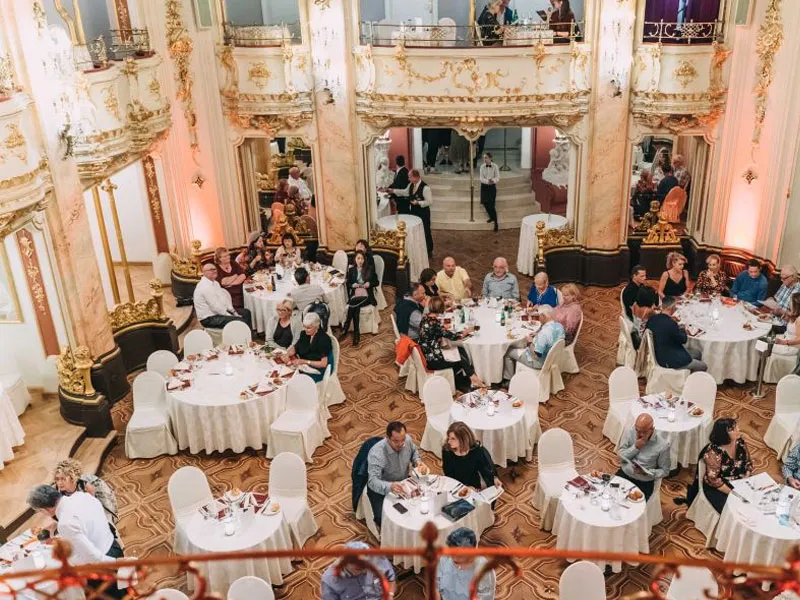
Photo: elegant multilingual business dinner Prague luxury restaurant executive, via czechia-prague.com
There is a particular kind of silence that falls over a dinner table when a conversation stalls—not from lack of interest, but from lack of the right bridge. For American executives operating in Central Europe, that silence can carry real professional consequences. A missed nuance, a misread gesture, an unintentional breach of social protocol: these are the invisible costs of navigating unfamiliar cultural territory without the right support.
In Prague, a city that has long served as a crossroads between Western ambition and Eastern European sophistication, a growing number of high-profile international clients are discovering that elite companions represent far more than social company. They represent a form of cultural fluency that no app, consultant, or briefing document can fully replicate.
Beyond Translation: The Architecture of Social Intelligence
Fluency in a foreign language is, by itself, a modest credential. What distinguishes truly exceptional companions in Prague's premium market is something considerably more layered: the ability to read a room, calibrate tone, and navigate the unspoken grammar of social interaction across multiple cultural contexts simultaneously.
Consider the dynamics of a business dinner involving a Czech partner, a German investor, and an American client. Each brings distinct expectations around formality, directness, humor, and hierarchy. A companion with genuine cross-cultural competence does not simply translate words—she translates intent. She understands when a Czech executive's measured silence signals respect rather than reluctance, when a German counterpart's directness should be contextualized rather than taken as confrontational, and when an American's instinct toward informality might be received as either refreshing or inappropriate depending on the moment.
This calibration—invisible when executed well, catastrophic when absent—is precisely what separates elite companion services from conventional business entertainment arrangements.
The Social Facilitator as Professional Multiplier
American executives who have worked extensively in Europe often describe the same phenomenon: formal meetings produce agreements, but it is the informal social environment—the dinner, the evening, the unscripted conversation—where genuine trust is built. This is not a uniquely European dynamic, but it is one that Central European business culture has refined into something approaching an art form.
Prague, in particular, operates on relationship capital. The city's most influential business networks are not primarily transactional; they are relational. Access is earned through demonstrated cultural awareness, through the willingness to engage seriously with local customs and intellectual traditions, and through the quality of one's social presence.
An elite companion who moves fluently through these environments—who can engage a Czech industrialist in a substantive conversation about the city's architectural history, pivot gracefully to discuss contemporary European economic policy, and do so in two or three languages without visible effort—becomes something more than a social companion. She becomes a multiplier of professional credibility.
For the American executive who arrives in Prague with strong business acumen but limited regional context, this kind of support is not a luxury. It is a strategic investment.
Cultural Nuance as Competitive Differentiation
The business case for culturally intelligent companionship becomes clearer when viewed through the lens of competitive differentiation. In global markets where products, services, and pricing are increasingly comparable, the quality of human relationships often becomes the decisive variable.
Research in international business consistently demonstrates that cross-cultural rapport—genuine, not performative—accelerates deal timelines, reduces friction in negotiations, and increases the likelihood of long-term partnership. Yet most executives receive minimal formal preparation for the social dimensions of international business. They arrive in a foreign city equipped with spreadsheets and pitch decks, but without a meaningful understanding of how to build the human connections that will ultimately determine whether those materials ever get serious consideration.
Elite companions in Prague's premium market have, in many cases, cultivated precisely this understanding through years of engagement with international clients across diverse professional backgrounds. Their knowledge is not theoretical—it is experiential, refined through thousands of hours of sophisticated social interaction with executives, diplomats, academics, and cultural figures from across the globe.
The Discretion Dividend
One dimension of this arrangement that American clients frequently cite as particularly valuable is the discretion that elite companionship inherently provides. A companion is not a colleague who will carry office politics into a social setting. She is not a local contact whose loyalties and agendas may be unclear. She is a professional whose interests are aligned entirely with her client's comfort, confidence, and success within a given social environment.
This creates a rare kind of psychological safety. The executive can ask questions he might hesitate to raise with a business associate. He can acknowledge uncertainty about local customs without professional embarrassment. He can rehearse talking points, seek honest feedback on his social approach, or simply decompress from the pressures of international travel in the company of someone genuinely skilled at human connection.
In high-stakes professional environments, that kind of safe harbor has measurable value.
Reframing the Conversation
The American professional culture has been slow to recognize what European executives—particularly those in Germany, France, and the UK—have understood for decades: that the social dimensions of international business are not peripheral to professional success. They are central to it.
Elite companions who bring multilingual capability, cultural depth, and sophisticated social intelligence to their engagements are not simply providing personal company. They are filling a genuine gap in the professional support ecosystem—one that no executive assistant, cultural consultant, or hospitality service has yet managed to address with equivalent effectiveness.
For the discerning American executive preparing for a significant engagement in Prague, the question is not whether this kind of support has value. The question is whether they can afford to arrive without it.